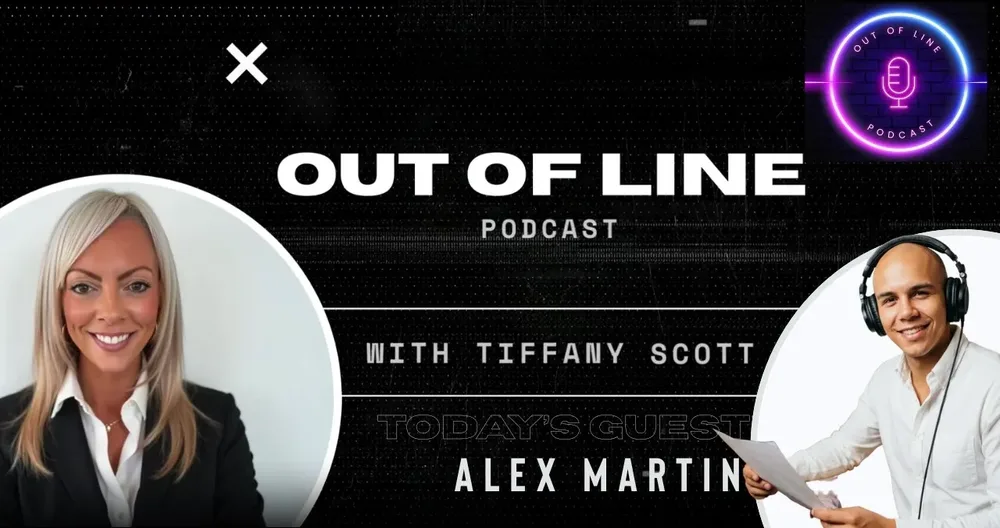
Ep. 7 of Out of Line with Tiffany Scott, with Alex Martin.
There's an unwritten rule in corporate America: find a lane and stay in it. Alex Martin never got that memo. He started playing music on Venice Beach with his family when he was five, did community outreach for the New York Yankees, and then built a healthcare staffing career that led to his own firm.
Episode 7 is full of choices that would make a traditional staffing exec nervous. No KPIs, a fully remote team, and no CRM. It works for him, and his reasons are worth hearing.
Alex is the founder and CEO of Amaya Staffing Consultants, a remote boutique recruiting firm built around two words: people matter. He started his staffing career in accounting and finance. After his time with the Yankees, he came back to staffing when the pandemic hit and became the top salesperson in a new healthcare division, reaching a million dollars in sales in his first year. Today Amaya places clinical roles from RNs up to medical directors and CMOs, along with operations, HR, accounting and finance, some legal and executive work, and recruiters for other staffing firms. When we recorded, he had a team of 10, including three recruiters in Colombia.
With 1,000 to 2,000 jobs open at any given time, Alex doesn't spread his team across all of them. He points each recruiter at the highest-impact roles that fit their strengths. His recruiting manager works a medical director search because she has placed more healthcare candidates. Another recruiter takes accounting and finance.
"I don't have KPIs for my people. I don't. I just have focus."
That doesn't mean no accountability. He hires people with their own goals outside the company, like buying a house or starting a family, and he watches some people more closely than others. But he isn't babysitting. He took that from his time with the Yankees, one of the few teams with no names on the backs of the jerseys. They operate as one organization.
Alex gets messages that are obviously canned every day, and he can tell. He told me one thing he automatically rejects is the extra-long em dash, because it signals that you didn't put in the effort to write the message yourself.
"You have to do your research. You have to you need to know who you're talking to."
He gave me a great example. Before a call with a client, he listened to the client's entire podcast episode, 20 to 30 minutes, and brought up something mentioned at the very end. The client was floored. That's what separates a recruiter from someone doing real market analysis.
So how does he have time for that kind of research? AI.
"AI has become a force multiplier. I don't look at it as a thinker."
He uses it to condense the information he's looking for, and then he writes the email himself. He also uses it to help work out email addresses, which is part of why he dropped his ZoomInfo subscription. Use the tools to save time on research, but keep your own voice in the message.
Alex does all of the business development himself. Everyone else on the team is delivery: they source, they schedule, and they write short summaries explaining why each candidate earned a spot on his calendar. Then he talks with every candidate. He knows this will become a choke point as he grows, and he says so. For a firm his size, though, it keeps him close to everything and protects the brand.
Lean also applies to his tools. He dropped his CRM because the team wasn't using it the way it should be, and now everyone tracks every candidate in a shared Google Sheet. He expects to go back to a CRM when the firm gets much bigger.
Alex screens hard for soft skills on the first call. He won't present someone who has the skills but can't hold a conversation.
"I'm not going to put my name, this company on the line to my client."
And for every candidate who doesn't get the job, he insists on treating them with dignity. When I asked what recruiters are getting wrong with candidates, he didn't hesitate:
"Being transactional, not being communicative and ghosting. Don't ghost on these people."
Alex's first job order didn't come from a client list. It came from someone he'd known since his first healthcare staffing role, who had been watching his growth on LinkedIn. He filled it in the first month. He also had to learn collections the hard way: his first client paid far past terms, and he had funded the launch on credit cards. If you're about to go out on your own, build the network early and set up your AR process before you need it.
Look at your open reqs this week and pick the five with the highest impact. Point each recruiter at the ones that fit their strengths, and let the rest wait. Before your next prospect call, spend twenty minutes on something the buyer actually said or published, and open with it. If a tool in your stack isn't being used, be honest about it.
Find Alex at Amaya Staffing Consultants (amayastaffing.com) and on LinkedIn (linkedin.com/in/alex-martin-61140761).
Alex wins clients by doing real research before he reaches out. myScout does that research for staffing reps, pulling together hiring signals, decision-makers, and how each one prefers to communicate, so the message you write is your own.
Get started today. See which companies actually use agencies, who owns the decision, and how they want to be approached.
Get Started →We start with your company: how you sell, who you want to win, and where you want to grow. Then we show you exactly how myScout fits that. No canned walkthrough.
No. Start now and book a demo any time, before or after you buy.
Scout Pro is $199 and Scout Signature is $299, per user a month. Month to month, or pay annually and get 2 months free.
No. Unused credits carry forward as long as your plan is active.
That is Enterprise, priced around your team size. Contact us and we will build it with you.