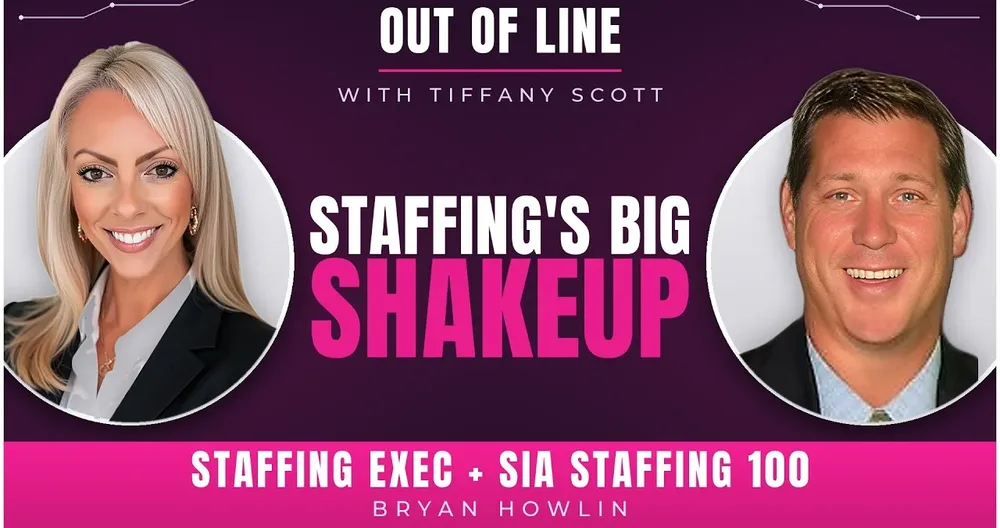
Ep. 16 of Out of Line with Tiffany Scott, with Bryan Howlin.
Bryan Howlin has spent 28 years in staffing, from Aerotek and Randstad to running sales at Revature through a private equity sale. On Episode 16, he was done being polite about where the industry is headed. We covered the big public firms struggling, PE pressure, offshore recruiting, the MSP model, and AI.
The thread running through all of it is a question every staffing seller should ask: are you actually close enough to your client to solve their problem?
Bryan started in IT staffing in the mid-90s, when COBOL developers were the hardest thing to find. His career runs through Aerotek, Randstad, and Revature, where he led sales through a private equity sale. He's managed teams in multiple markets, including tech in Charlotte, and he describes the industry as a place where everybody knows everybody.
Bryan's view is that the MSP model is running out of road. Clients are bringing more hiring in-house and buying project-based work, and AI is changing what they need. If he were a CIO, he said, he wasn't sure he'd want an MSP. He'd rather put simple controls in place: a list of preferred vendors, and managers explain why they're going outside it.
I'll be honest, I think the MSP model makes the most important decision a company makes, bringing a person into its culture, transactional. Bryan added that the people servicing the client become transactional too:
"They don't know how to ask right consultative questions."
What does Bryan want instead? He said it plainly:
"I want partners that are intimate, that know what my business is, know what my struggles are, know exactly what we're dealing with."
Sometimes that means a contractor. Sometimes it's a re-engineering project the client doesn't have people for. If you can't do it, do you have a channel partner who can? For Bryan, that's what transformation should actually mean, not a buzzword with no plan behind it.
Bryan told me about a smaller firm in Atlanta that's doing well because the owner hired a smart CSO and invested in building infrastructure before asking salespeople to sell an AI offering. Compare that with firms that call themselves "AI agnostic" without being able to explain what that means. His point was that there's a lot of opportunity right now, because so many firms are still doing the same old thing.
He also flagged the pressure from private equity money in staffing. A firm might be told it needs to go from 50 to 250 in four years, and Bryan's question is simply how. My experience with PE is that they do push for the strategy. Either way, growth targets without real infrastructure behind them are a slogan.
When I said clients now care more about who they're getting than about getting twenty resumes in an hour, Bryan said culture is the ground of everything. Accountability and expectations matter, but people have to want to be there.
"You can go somewhere else if it's a better cultural fit and just take your book, your Rolodex with you."
So many firms have popped up in the last 20 years that a strong producer has options. I added that accountability isn't the enemy. It works when expectations are set from day one, not sprung on someone who missed their numbers.
We traded war stories. Bryan's first start was a COBOL developer headed to Lockheed Martin who backed out with a family-emergency story, and two weeks later Bryan saw him walking into the company next door with a new badge on. I learned to document everything for the same reason. The lesson for today is the same: competition is so tight that you have to be good at qualifying questions, because one mishap can cost you a client who has plenty of other firms to call.
When I asked about his biggest regret, Bryan said it was how he left his first role. He was young and arrogant, and it was disrespectful to his family. The wake-up call was his wife telling him he was being an asshole. Rebuilding meant swallowing some humility while keeping the drive.
"So confidence, not cockiness."
His advice to anyone selling staffing: we're in the people business, so be a good person. If someone isn't getting it done, move on, but do it the right way and treat people with respect. If it's only about the numbers, he said, you won't make it through this transformation.
Pull your top ten accounts and ask yourself, honestly, how much you know about each one's business beyond the open reqs. Where it's thin, book a meeting that isn't about a job order. Ask what they're building, what's changing with AI, and where they're stuck. If you can't help with the answer, find a partner who can. That's the consultative seat Bryan is describing.
Connect with Bryan on LinkedIn: linkedin.com/in/bryan-howlin-9447681
Being consultative starts with knowing the account before you call. myScout gives staffing reps the hiring signals and decision-maker insight to show up with real questions, not a rate card.
Get started today. See which companies actually use agencies, who owns the decision, and how they want to be approached.
Get Started →We start with your company: how you sell, who you want to win, and where you want to grow. Then we show you exactly how myScout fits that. No canned walkthrough.
No. Start now and book a demo any time, before or after you buy.
Scout Pro is $199 and Scout Signature is $299, per user a month. Month to month, or pay annually and get 2 months free.
No. Unused credits carry forward as long as your plan is active.
That is Enterprise, priced around your team size. Contact us and we will build it with you.