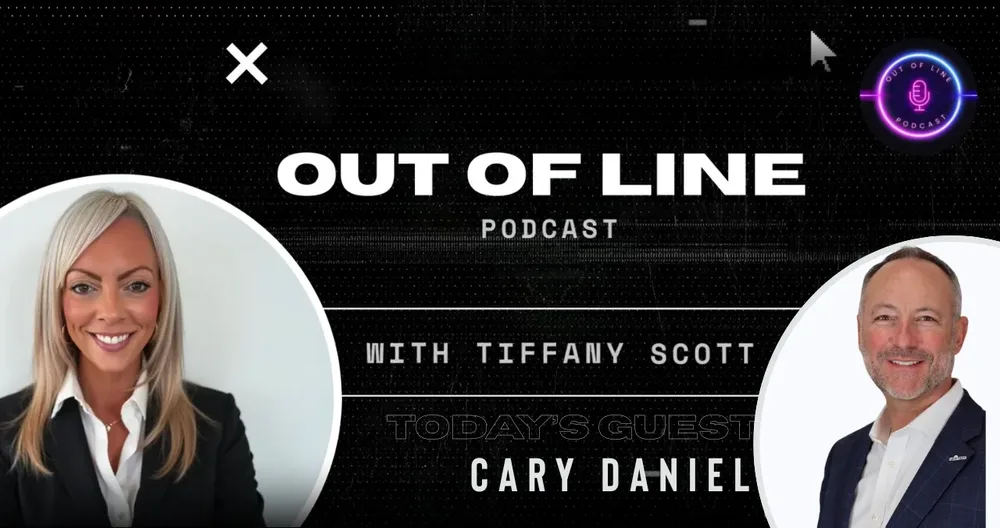
Ep. 3 of Out of Line with Tiffany Scott, with Cary Daniel.
Cary Daniel has been in staffing for about 30 years. He has built three Inc. 500/5000 companies, been part of more than 20 M&A deals, and helped grow a business to $100 million in revenue. You'd think someone with that track record would be protective of the model that got him there. Instead, he tore it down.
On Episode 3, we talked about how Cary got his start behind a day labor counter, what he and his partner got wrong when they first went out on their own, and why he rebuilt the NEXTAFF franchise model around a question every owner should ask more often: why do we do it this way?
Cary is a staffing industry veteran and the founder of the NEXTAFF franchise. He runs the business as CEO alongside his longtime partner James, who serves as COO. He also started the Be LegenDary Landon Daniel Foundation in honor of his son, and today it operates as part of the University of Kansas endowment.
Cary started at Labor Ready, with hundreds of people a day at the counter. He moved into a district manager-in-training role at a light industrial firm the day before it sold to SOS Staffing in a rollup. Within about six months, the three people above him were gone. He'd opened and run multiple offices, so he figured he knew everything about staffing. In 1998, he and James went out on their own.
"in a very short order realized we didn't know what we didn't know."
The first client asked for a certificate of insurance, and they had no idea what that was. He says they spent about two years bumping their heads against the back-office side: contracts, insurance, everything that keeps the front end running. If you're thinking about leaving a big firm to start your own, plan for that learning curve, because it will hit you.
They named their first company Human Resource. It was a big, familiar name that caught people off guard on cold calls.
"all we were looking for was something that sounded bigger than we were and some kind of interrupt."
Cary's point goes beyond branding. He says you can tell an owner's mindset from what they name the business. Talking big from day one also helped them recruit talented people, because they could sell a vision of 50 markets instead of a job as employee number two at a tiny shop.
Their first real client was a hotel. That led to another hotel, then another, and within a couple of years they were the hospitality staffing niche in their market. He says it happened purely by accident. Look at where your last few wins came from. The niche you're already winning in might be the one to lean into.
This was the meat of our conversation. Cary kept hearing the same reasons people didn't buy a staffing franchise: no sales background, not enough startup capital, and not wanting to sign a lease or hire a full-time staff right away. So in 2025 they launched a virtual model. That meant the technology had to be solid, and franchisees without a B2B sales background needed orders to work. They focused on VMS and MSP business in healthcare, and by the end of 2025, he says, they had about 5,000 open job orders through those channels.
Then they got rid of territories.
"If we open it up nationwide and they can recruit nationally, they can fill orders from all over."
His next question was simply why franchisees would need a territory at all.
He was honest that it created new problems, like how to split an order that's sold in Texas, based in Virginia, and filled in California. But the change started from market feedback, not a whiteboard. If you keep hearing the same objection, that's not a sales problem. It's a model problem.
Cary speaks and trains, and he has no patience for talks that send people out excited and empty-handed. He turns his sessions into workshops.
"I want you to walk out of there going, I left here better than when I came in."
That's a good standard for your own sales meetings, too. Did the client leave with something useful, or just a nice impression of you?
We both agreed that "work-life balance" is overused. Cary never ran his life on a strict schedule. If the golf tournament started at 1:00, he worked from 6:00 to noon, went to the tournament, and worked again that night if he had to. His proudest accomplishment from 25 years as an entrepreneur, he says, is that he doesn't think he ever missed a practice, game, play, recital, or band concert.
Write down the three objections you hear most from prospects or franchise candidates. For each one, ask whether it's a sales problem or a model problem. If it's the model, fix the model instead of polishing the pitch. And if you're small, decide how you want to present yourself on purpose, so the name and the story match the business you're building.
Find Cary at carydaniel.com, on LinkedIn (linkedin.com/in/carydaniel), and at NEXTAFF (nextaff.com). Learn about the Be LegenDary Landon Daniel Foundation at belegendaryfoundation.org.
Cary rebuilt his model around the orders his franchisees could actually win. Pointing reps at the right demand is the same problem myScout works on: knowing which companies are hiring and using agencies before you spend a dial on them.
Get started today. See which companies actually use agencies, who owns the decision, and how they want to be approached.
Get Started →We start with your company: how you sell, who you want to win, and where you want to grow. Then we show you exactly how myScout fits that. No canned walkthrough.
No. Start now and book a demo any time, before or after you buy.
Scout Pro is $199 and Scout Signature is $299, per user a month. Month to month, or pay annually and get 2 months free.
No. Unused credits carry forward as long as your plan is active.
That is Enterprise, priced around your team size. Contact us and we will build it with you.