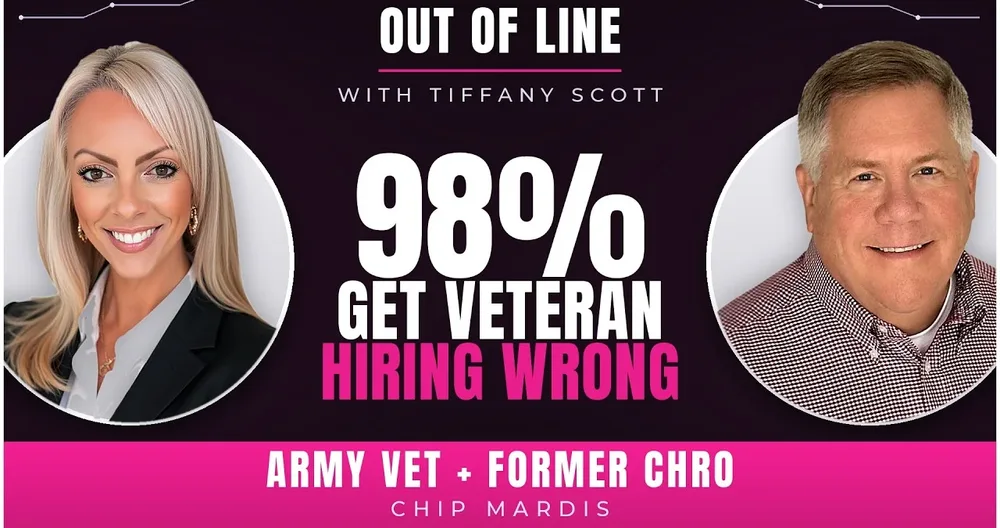
Ep. 17 of Out of Line with Tiffany Scott, with Chip Mardis.
Chip Mardis has seen hiring from both sides of the desk. He spent his career in HR, made it all the way to chief human resources officer, and then started a staffing firm. Now he's the one trying to get HR to take his call.
On Episode 17 of Out of Line, we talked about why most companies have no idea what to do with veteran talent. We also talked about what it's really like to build a staffing business when you're used to running the department on the other end. If you own an agency or sell staffing services, a lot of this is going to sound very familiar.
Chip is an Army veteran. He was a captain, got called up for Desert Storm, and then spent his career in HR, eventually becoming a chief human resources officer. Today he runs Blue United Sourcing with his daughter. They place veterans and military spouses in leadership, management, skilled trades, and IT roles.
This is the part every staffing seller needs to hear. When Chip started doing business development, he went after it the way most of us were trained to: volume, pressure, keep pushing. It didn't work.
"I was trying to be transactional. Sell, sell, sell, sell, sell. And I wasn't selling anything."
What changed was letting the relationship lead. He realized he was, in his words, "trying too freaking hard." I've lived this one myself. The harder you push a prospect who doesn't know you yet, the faster they put up a wall.
Relationships don't replace outreach. Chip still picks up the phone. What matters is what he asks for when he does:
"Hey look, I I got something really unique. Can I take thirty minutes and if there's an opportunity for you?"
That's a small ask. He's not asking for an MSA or a req. He's asking for half an hour to find out whether there's a fit at all. After that, it's on you to make the case clearly enough that they're willing to take a chance on you.
Most of Chip's growth has come from introductions. Former military officers who moved into corporate jobs already know what junior military officers and NCOs can do, and they've opened doors for him. That word of mouth also got him into work he didn't plan on, like placing cybersecurity, help desk, and data people for smaller IT managed service providers.
The takeaway for agency owners: your best referral sources are the people who already understand what's special about your candidates. Find them and stay close to them.
I asked Chip something that has bugged me for 25 years: why won't HR just look at a resume? It costs them nothing. He's sat in that seat, and he didn't sugarcoat it:
"every HR director, every chief human resource officer they have blinders on and their blinders are often within the four walls of that of that company."
He was clear that this doesn't excuse it. But it's the reality you're selling into. In his experience, the HR leader who looks past their own experience and takes a chance on something new is the exception, not the rule. It gets even harder when that something is military talent, because less than two percent of Americans have any connection to the military. If your pitch assumes the buyer already gets why your candidates are valuable, you've lost before you started.
We both changed course from what we first had in mind. I started out planning to be a lead gen company, and Chip's business found its groove once he leaned into what the market actually wanted. Pick the overlap between what clients are asking for and what you're truly best at. You can't be great at everything.
When I asked what advice he'd give someone starting a business, Chip went straight to a line from his retail days: cash is king. As an HR leader, he always ran his departments as profit centers. As a new founder, he admits he didn't hold himself to that.
"You never built a church for Easter Sunday. I I should have built it for the confessional."
He went all in on infrastructure before he needed it, and he's been scaling back since. Build for the business you have today, not your best-case day.
Go through your prospect list and swap the next pitch for a request. Ask for thirty minutes to learn whether there's a fit. Then list the people who already believe in your niche, like former clients, placed candidates, and partners, and ask each of them for one introduction this month. Before you add overhead, check whether today's revenue actually needs it.
Find Chip at Blue United Sourcing (blueunitedsourcing.com), on LinkedIn (linkedin.com/in/chipmardis), and through Civilian Ready (civilianready.org).
Chip's lesson is the one I built myScout around: the first conversation goes better when you already know something real about the company you're calling. Have that conversation first, and let the selling follow.
Get started today. See which companies actually use agencies, who owns the decision, and how they want to be approached.
Get Started →We start with your company: how you sell, who you want to win, and where you want to grow. Then we show you exactly how myScout fits that. No canned walkthrough.
No. Start now and book a demo any time, before or after you buy.
Scout Pro is $199 and Scout Signature is $299, per user a month. Month to month, or pay annually and get 2 months free.
No. Unused credits carry forward as long as your plan is active.
That is Enterprise, priced around your team size. Contact us and we will build it with you.