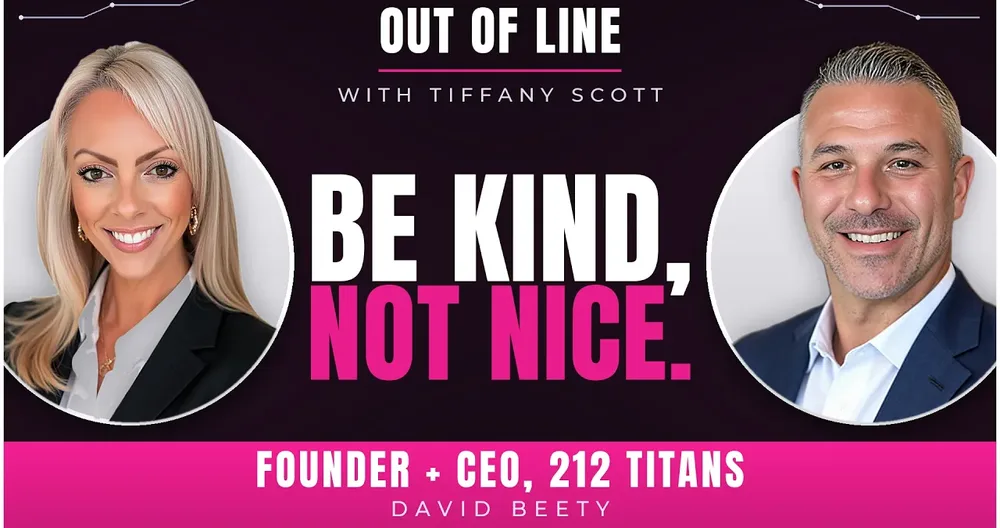
Ep. 15 of Out of Line with Tiffany Scott, with David Beety.
I met David Beety in 2018, and he turned out to be one of the best colleagues I've ever had and a close friend. Episode 15 was the first "after hours" Out of Line, and it felt like one. Dave doesn't soften anything about the industry he has spent his career in.
"I think the staffing industry, whether we like it or not, has earned the bad reputation that it has."
His answer is a firm built to be the exception, and it comes with a specific operating model you can copy.
Dave is the founder and CEO of 212° Titans. The name comes from the boiling point of water. At 210 or 211 degrees, water is just hot. At 212, you get steam, and steam powered the locomotive. His firm's process is built around a framework he calls STEAM, which he described as the culmination of his entire career. He has also built a career on channel partnerships.
The most practical thing Dave said was about intake. He doesn't want the JD. He wants to come to your office.
"Don't send me your job description. I'm coming to your office. I want to meet the team."
He wants to know why the role is open, what didn't go well with the last person, the top three responsibilities, and the tangibles and intangibles. Then he takes that understanding to the market. If your intake is a form and a quick call, you're competing on volume. Dave competes on depth.
Dave told me about a client who had already interviewed 11 candidates from other firms and turned them all down. His team interviewed more than 43 candidates and sent her one. She told him she'd never been more floored in her life. Dave offered the two remaining candidates owed under his three-for-one rule, and she didn't want them. That person had done the job and was a culture fit with the right experience.
The industry has trained clients to expect a pile of resumes they have to weed through. Doing the screening the client was hoping you'd do is a differentiator in itself.
Dave says everyone in staffing claims to be good. He wanted clients to be able to hold something tangible: a repeatable, scalable process where they can see which step they're in and what the assessment tells them.
"But if you put a people first organization with a scalable process, you're dangerous to the market."
I pushed on this, because most firms say their differentiator is their people, and I'm not sure they know that it isn't. Dave's view is that you need both. People matter most, but a process clients can see is what keeps quality consistent no matter who's working the search.
Some of Dave's process came from years of client and candidate feedback. One example: a candidate thanking his team for calling to say they weren't selected. That's a big deal compared with getting ghosted, a cold email, or a text. Small courtesies like that add up to a reputation, especially in an industry that has earned a bad one. Dave says he has always played the long game. A rejection call costs you five minutes, and it's how that candidate will remember you.
Dave knew his quota existed, but he trained himself to solve the other person's problem first. With channel partners, his first question after understanding someone is whether an introduction would be helpful to them. He also said every conversation is a building block of the relationship.
"It's listening to understand as opposed to listening to respond, right?"
I admitted to him that I wasn't naturally curious about people and had to work at it as a recruiter. His point was that sales training teaches stories and questions so you'll get people talking, but if you're genuinely interested, it comes naturally.
This is the line the episode is named for, and Dave said he borrowed it. Nice is telling someone they're trying so hard while they still aren't getting it done. Kind is asking what you can do to help them own the expectations, whether that's autonomy, guidance, coaching, support, or resources. He tells people the truth, trusts them with information, and never tells anyone to do it his way, only how he did it. He also said leadership is the worst behavior you're willing to tolerate. For staffing managers who avoid hard conversations to stay liked, that one stings.
On your next new job order, push for an in-person or video intake with the hiring team, not just the JD. Ask why the role is open and what didn't work with the last person. Then write your process down in steps a client could follow. If you can't explain it on one page, your client can't tell you apart from the next firm either.
Find Dave at 212titans.com and on LinkedIn (linkedin.com/in/david-w-beety-aaa43956).
Dave's edge is knowing the client before he ever sends a candidate. myScout helps you do that homework before the first call, showing who's hiring, who makes the decision, and how they like to communicate.
Get started today. See which companies actually use agencies, who owns the decision, and how they want to be approached.
Get Started →We start with your company: how you sell, who you want to win, and where you want to grow. Then we show you exactly how myScout fits that. No canned walkthrough.
No. Start now and book a demo any time, before or after you buy.
Scout Pro is $199 and Scout Signature is $299, per user a month. Month to month, or pay annually and get 2 months free.
No. Unused credits carry forward as long as your plan is active.
That is Enterprise, priced around your team size. Contact us and we will build it with you.