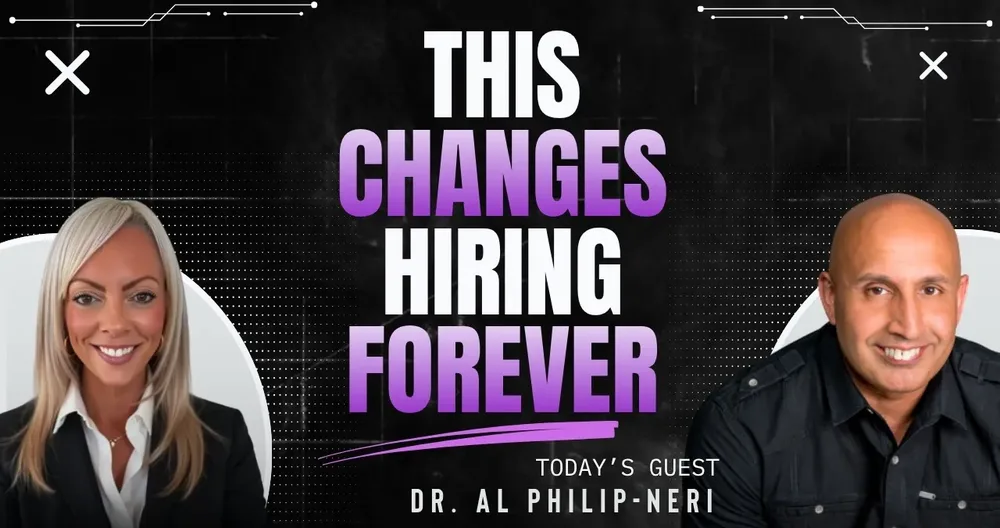
Ep. 13 of Out of Line with Tiffany Scott, with Dr. Al Philip-Neri.
Dr. Al Philip-Neri was the first guest I had on Out of Line who didn't come from staffing. When he pitched the episode to me, he said it had everything to do with staffing and hiring. He was right.
Al has worked in corrections, competed as a fighter, built teams in real estate, and earned a doctorate studying how teams hold together under pressure. On Episode 13, he even ran a live read of my own behavioral assessment. For staffing owners and recruiters, though, the real value is how he thinks about predicting whether someone will succeed in a role before you look at their resume.
Al is the founder of Cohesion HQ, a performance advisory firm, and the author of The Execution Advantage, which lays out his framework for aligning talent, leadership, and culture so teams can perform under pressure. He was clear that the behavioral assessment he uses isn't his own creation. He licenses it from a partner company and interprets the results for clients. His path included working as a phlebotomist and doing minority recruitment for his university while in college, then corrections work with at-risk youth, real estate, and doctoral research on cohesion in high-stakes environments.
This was the most useful part of the conversation for anyone filling hourly roles. Al used the call center example: $15 to $20 an hour, inside sales, cold calls all day. You don't need a decision-maker in that seat. You need someone who can take a hang-up and keep dialing. Someone who wears their heart on their sleeve will struggle.
He said the same goes for door-to-door sales like solar, roofing, and siding:
"You need somebody that is able to be like next, next, next, and they'll tell you in an interview because they're dying for a job that they can do it, right?"
That's the trap. Candidates will tell you what you want to hear. His approach is to look at behavior first, then move on to resume, education, certifications, and experience.
Al used himself as an example. His profile is highly influential, directing, urgent, and visionary.
"So the thing is if you were looking at me as second in command, I'd be a bad hire, right?"
He said that if an executive recruiter saw his profile, they should tell him he's not a COO and find him a CEO seat, because as a number two he'd challenge everything. If you place executives, that's a sharp way to think about fit. The question isn't only whether someone is talented. It's what seat their wiring belongs in.
Two executives can both be visionaries and get there very differently. One makes decisions autonomously and is willing to die on their sword, and that often comes with intimidation and a cocky reputation. The other gets to the vision collaboratively. Neither is wrong. It depends on what the company needs right now. Ask your client which one they actually need, not just which one interviews better.
Al cited Gallup data that only 56% of middle managers have had any kind of training, and usually that's one basic course.
"oftentimes what we find is they were promoted because they were excellent at their job."
Being excellent at your job, he said, doesn't make you excellent at leading people. Staffing does this constantly: the top biller becomes the manager with no preparation. I shared the story of a webinar attendee who finally let go of a toxic leader after 14 years. Al called legacy hires the worst.
Al is working with a warehouse company where many middle managers are former felons, used to solving problems through silence or intimidation. Someone had pitched the HR director a difficult-conversations workshop, and Al told her it would go in one ear and out the other. His approach is to meet those managers where they are, without lowering the bar:
"I'm not talking about decreasing standards or decreasing intensity. If anything, I'm telling you we're gonna increase standards, we're gonna increase intensity."
What changes is the method. It has to be systematic and clear, and people either get on board or turn out not to be the right fit.
Al's doctoral research looked at how cohesion gets built in high-stakes settings like athletics, law enforcement, and corrections. His framework uses five pillars that create communication clarity, which leads to role clarity, which leads to cohesion. But, he says, cohesion doesn't guarantee execution, so the next step is training teams under pressure. Think of a kid learning to ride a bike when the training wheels come off. For staffing firms, cohesion means clients get the same reliable people, not constant turnover.
Pick one high-volume role you fill often and write down the behavior that actually predicts success in it, like how someone handles a hang-up or a no. Build two interview questions that test for that behavior instead of asking candidates whether they have it. Then look at your own org chart and ask whether your last promotion was for leadership or for production.
Connect with Al at Cohesion HQ (teamcohesionhq.com), on LinkedIn (linkedin.com/in/alphilipneri), and find the book at theexecutionadvantage.com.
Al's work is about understanding how a person operates before you put them in a seat. We use the same idea at myScout with DISC-informed insights, so reps know how a buyer likes to be approached before they reach out.
Get started today. See which companies actually use agencies, who owns the decision, and how they want to be approached.
Get Started →We start with your company: how you sell, who you want to win, and where you want to grow. Then we show you exactly how myScout fits that. No canned walkthrough.
No. Start now and book a demo any time, before or after you buy.
Scout Pro is $199 and Scout Signature is $299, per user a month. Month to month, or pay annually and get 2 months free.
No. Unused credits carry forward as long as your plan is active.
That is Enterprise, priced around your team size. Contact us and we will build it with you.