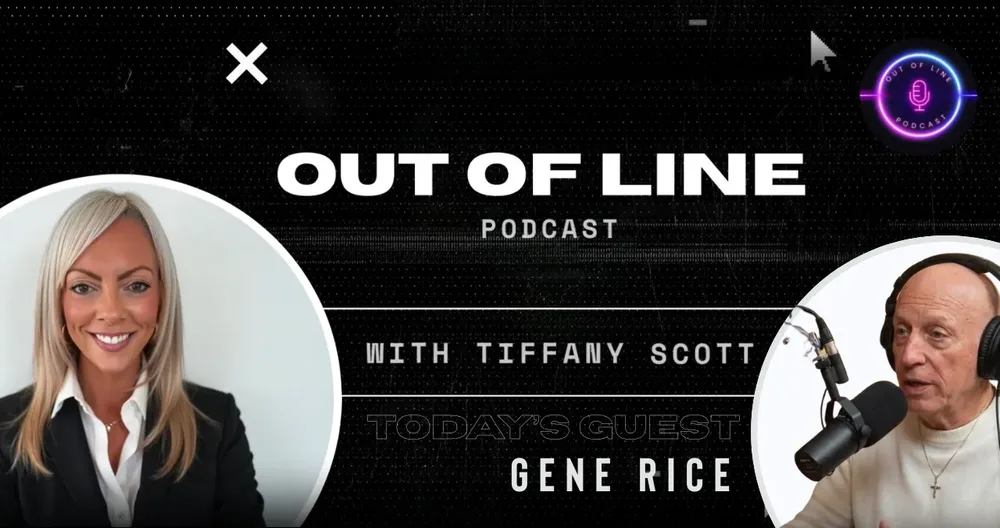
Ep. 1 of Out of Line with Tiffany Scott, with Gene Rice.
Gene Rice was my very first guest on Out of Line, and I couldn't have asked for a better way to kick off the show. He co-founded Rice Cohen International, which has completed more than 1,000 retained searches and placed more than 200 C-suite executives. Before any of that, he owned a bar.
That path is exactly why I wanted him first. Gene didn't walk a straight line into executive search. He got there through the service industry, a big corporate career, and a few hard lessons, and every one of them shaped how he built his firm. If you own a staffing or search firm, or you're thinking about starting one, these are the lessons worth stealing.
Gene is the co-founder and chairman of Rice Cohen International, an executive search firm. Before search, he spent years in corporate sales and management with a division of a Fortune 100 company, and his last role there was running East Coast operations with 1,500 people. He also co-founded the Plant a Seed Foundation, which supports underserved youth, and co-wrote Grad to Grown, a guide for young professionals, with his daughter Courtney.
Before Gene and his partner Jeff landed on executive search, they looked at a lot of businesses. One of them was distributing medical devices for a manufacturer in China. The deal looked great on paper. Then they tested the supply chain, ordered a product through a distributor, and it took about nine weeks to show up. That ended it.
"We need to be in a business where success is based on us. If we fail, it's because of what we failed doing, not something out of our control."
Staffing owners don't always think about it this way, but it's a real filter. Before you add a vertical, a service line, or a partner, ask how much of the result actually sits in your hands.
Gene learned that one the hard way. Earlier in his life he ran a popular club. He left to open his own place, assuming the relationships and the reputation would follow him. They didn't. As he put it, he made an ego decision. From then on, he says, he never took success for granted again, and he got much more calculated about every move.
If you've had a few great years in staffing, that's worth hearing. A good market makes everybody look smart. The owners who last are the ones who keep checking their assumptions when things are going well.
When Gene went into search, people told him he'd be on the phone every night with candidates who couldn't talk during the day. He refused. He worked nonstop from nine to five and kept his evenings for his family. His reasoning:
"if they can't find time between 9 and 5 to talk to me, then they're the wrong candidate or it's the wrong time."
I love this because it flips the script. A boundary isn't only for your sanity. It also qualifies people. He was also an early adopter of video interviews, so he could serve retained clients without living on an airplane.
Rice Cohen got acquisition offers early, and Gene and Jeff said no. The company had grown because of its team, and the team had real benefits: a dollar-for-dollar 401(k) match, profit sharing worth 15% of each person's W-2, fully paid health benefits, trips, and a convention. A sale would have wiped a lot of that out.
"I can't sell this company and feel that my team didn't reap anything out of this."
What finally made sense was a deal where, in his words, one plus one equaled more than two. That was a multibillion-dollar staffing company with 187 offices worldwide that wanted to put a Rice Cohen office in each of them. If you're thinking about an exit, that's a good test: does the deal make your people better off, or just you?
This was my biggest personal takeaway. A lynchpin is the pin at the end of an axle that keeps the wheel on. Gene asks the senior leaders he works with what their lynchpin is: the things they need every day, week, and month to keep the wheel turning. For him, that's meditating, exercising, reading, and family time. When he started dropping those, he says, it caught up to him.
He's placed CEOs whose resumes would blow you away and whose personal lives were falling apart. Professional success without that pin in place doesn't last. Owners in this industry get pulled in every direction, so I'll ask you what he asked me: what keeps your wheel on?
Gene has journaled every day for more than 25 years. It started after a cousin sent him a letter his grandfather had written to his father. It showed a gentler side of a man everyone had described as harsh.
"If life is worth living, it's worth recording."
That's not a sales tactic, but I'd argue it makes you a better operator. You remember what worked, what didn't, and why you made the calls you made.
Take an hour this week and write down what you control in your business and what you don't. Where you've handed off the outcome to someone else, decide whether that's still the right call. Then name your own lynchpin, the one habit that keeps everything else steady, and protect it on your calendar like you would a client meeting.
Connect with Gene on LinkedIn (linkedin.com/in/generice) or at Rice Cohen International (ricecohensearch.com). Learn more about the Plant a Seed Foundation at plantaseedfoundation.org.
Gene built a firm where the outcome sat on him and his team, not on luck. That's the same thinking behind myScout: put your time into the accounts that are actually hiring, and the effort you control starts showing up in results.
Get started today. See which companies actually use agencies, who owns the decision, and how they want to be approached.
Get Started →We start with your company: how you sell, who you want to win, and where you want to grow. Then we show you exactly how myScout fits that. No canned walkthrough.
No. Start now and book a demo any time, before or after you buy.
Scout Pro is $199 and Scout Signature is $299, per user a month. Month to month, or pay annually and get 2 months free.
No. Unused credits carry forward as long as your plan is active.
That is Enterprise, priced around your team size. Contact us and we will build it with you.