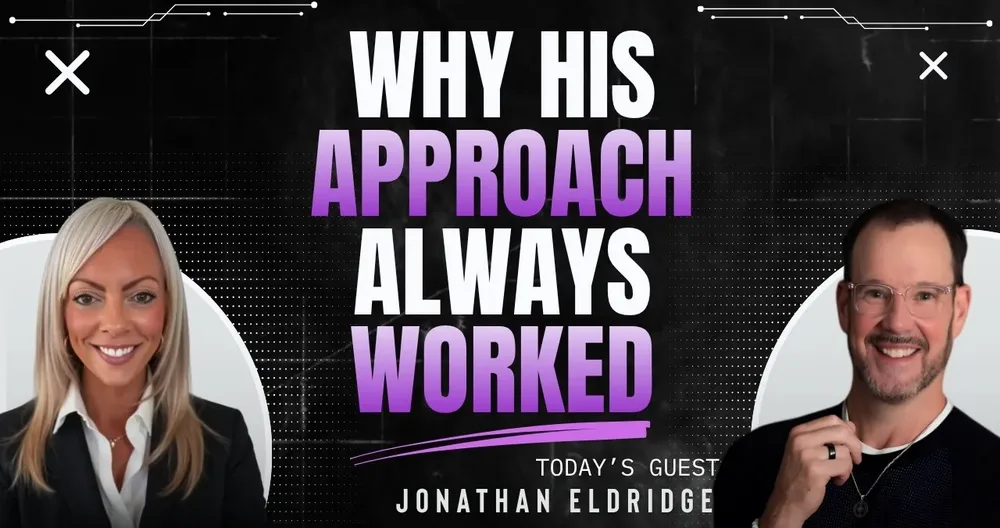
Ep. 14 of Out of Line with Tiffany Scott, with Jonathan Eldridge.
Jonathan Eldridge spent about 20 years in staffing. He helped grow a firm from the basement to a billion-dollar footprint, opened two markets from scratch, and became CXO of the whole organization. When I asked him what shaped his leadership, though, he didn't start with revenue. He started with a phone call from his account executive three months into his career.
Episode 14 is about leadership. If you run a staffing team, the lessons apply on Monday morning.
Jonathan is a bestselling author, keynote speaker, and founder of Soul Focus Mindset. His book is Struggle to Strength: How Authentic, Relatable Leadership Shapes Success. In staffing, he opened the Detroit office in 2002 for Ryan Hasbrook, who later founded the 8eleven Group, then rebuilt from zero in Philadelphia, and later served as CXO for an organization of roughly 700 to 800 employees, thousands of consultants, and hundreds of clients. He told me the NPS score he developed in that role was the highest in the industry.
Three months into Jonathan's career at a large technical staffing company, his brother died. The company preached family and teamwork, and it was going to give him two days of bereavement. His account executive, Ryan Hasbrook, told him he would make sure Jonathan was paid for every day he was out, even if he had to hand deliver the paycheck himself.
"man, this profession isn't about putting people to work. This profession is about you actually growing as a human, connecting with all kinds of different people."
That moment shaped everything after it. If you want loyalty from recruiters and account managers, it gets built in moments like this, not in the handbook.
Jonathan learned early, through a college public speaking class, that his personality was his biggest strength. In staffing, the skill that matters most is handling chaos.
"if you are if you can't adapt, like a client's gonna change a timeline, change a bill rate, consultant's not gonna show up."
If that kind of thing rattles you, he said, you're in the wrong industry. It's worth screening for when you hire your own desk.
When Jonathan opened Detroit in 2002, he was in a 400-square-foot office with one recruiter. On day three, his former employer, a $3 billion company, called and told him he couldn't go after Domino's because it was their account. His reaction was to thank them for the motivation. He remembers the date he hand delivered his first consultant paycheck, March 13, 2003. If a much bigger firm is calling to warn you off, that tells you that you matter.
When Ryan asked Jonathan and his wife to move to Pennsylvania, he said no twice before Ryan drove up and told him he needed him. Jonathan had to start over and make Philadelphia work, and he did it with a different leadership style than he used in Detroit.
"I embraced all of these college graduates. I taught them and I and I treated them like they were a leader."
They broke accounts together and took on the struggles together.
"Like it was a total team win or a total team loss."
Most staffing offices run new hires through a sink-or-swim period. Jonathan treated junior people like partners from day one, and that's how a market he called a long shot became a success.
Jonathan uses a road-rage example in his keynotes. When someone drives ten miles under the limit in front of you, you have no idea what they're dealing with.
"We need to be curious as opposed to being furious."
He calls life's daily obstacles speed bumps. You can hit them at 40 miles an hour and blame the bump, or slow down. In staffing, that applies to the candidate who ghosts you or the client who goes silent. Curiosity gets you the real reason. Fury burns the bridge.
Jonathan's trademarked C.A.R.E. framework gives everyone a core equation, a premier attribute they don't have to work on, and a couple of weaknesses to develop. His premier attribute is being authentic. He guessed mine on the spot. He said the framework works personally as well as professionally, and he shared the story of a medical school applicant who used it to prepare for interviews and was accepted everywhere he interviewed. For recruiters, the lesson is simple: know your natural strength, lean on it in front of clients, and be honest about the gaps.
Think about the last time someone on your team hit a hard personal moment. Did your policy or your judgment decide how it went? Write down what you want to do next time, before it happens. And when you open a new desk or market, give your newest people real ownership of an account early, with you working it next to them.
Connect with Jonathan at soulfocusmindset.com and on LinkedIn (linkedin.com/in/jonathan-eldridge-3497231).
Jonathan's teams won because they spent time on people, not busywork. That's why we built myScout: so your reps spend less time digging for leads and more time building real client relationships.
Get started today. See which companies actually use agencies, who owns the decision, and how they want to be approached.
Get Started →We start with your company: how you sell, who you want to win, and where you want to grow. Then we show you exactly how myScout fits that. No canned walkthrough.
No. Start now and book a demo any time, before or after you buy.
Scout Pro is $199 and Scout Signature is $299, per user a month. Month to month, or pay annually and get 2 months free.
No. Unused credits carry forward as long as your plan is active.
That is Enterprise, priced around your team size. Contact us and we will build it with you.