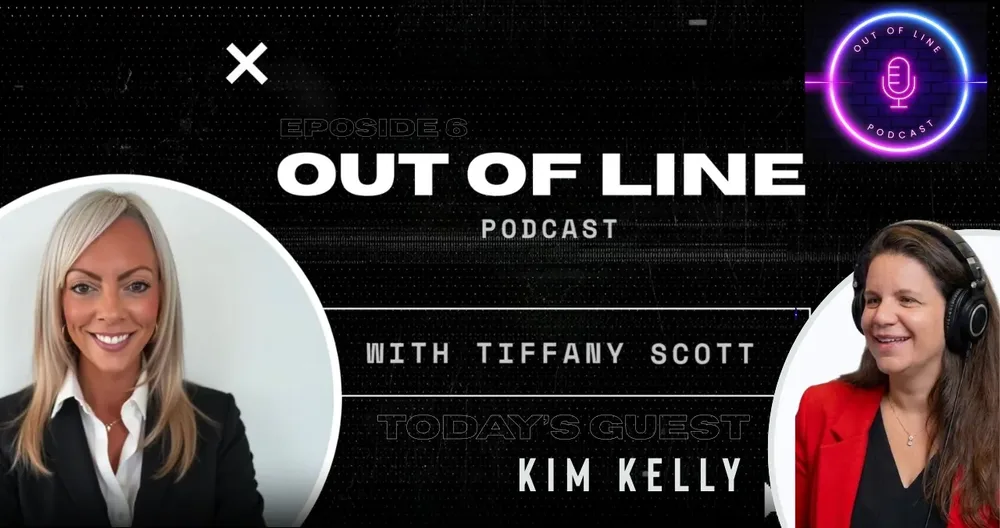
Ep. 6 of Out of Line with Tiffany Scott, with Kimberly Kelly.
Kimberly Kelly has done something a lot of people in our industry talk about and few actually do. After years running nine-figure portfolios at two of the biggest names in workforce solutions, she walked away from the corporate badge and started her own firm.
On Episode 6, Kim and I talked about how a Northwestern theater major ended up in IT recruiting, what she learned building an outsourcing business inside Randstad, and the problem she's now built AVENNI around. If you lead a recruiting desk, a branch, or a whole agency, I think you'll recognize that problem.
Kim is the founder and managing partner of AVENNI Consulting, a talent strategy and workforce transformation firm she launched in January 2026. She spent more than 13 years at Randstad, rising to VP of Global Client Solutions, and then served as EVP and Managing Director of Client Services Americas at AMS. Before staffing, she studied theater at Northwestern and co-founded a theater company in Chicago.
As she planned her next move, Kim talked with a lot of people across the industry, and one theme kept coming up. Teams are grasping and struggling to endure. When people are just enduring, she says, they get tired, afraid, and small. That leads to decisions that aren't about growth or performance.
That's why she built AVENNI around resilient leadership, which she defines as different from endurance and rooted in self-awareness. Self-awareness, she says, drives better decisions and better performance.
If your recruiters are grinding through the same desk every day just to survive the quarter, that's endurance. It might hold the numbers for a while. It won't grow them.
Kim had one of the clearest takes on fear I've heard.
"Fear's not bad. Fear means you're in a situation you haven't been in before and you have to make a decision to move forward."
The problem, she says, is when fear leaves a business stuck. Her examples were companies after a layoff, companies told to roll out AI that never made it from the boardroom to the desk, and products that can't get from idea to market. All of those show up in staffing right now.
Kim didn't sugarcoat the moment her role ended. She called it a door opening onto a new path, and said there are really two choices in that moment.
"I can either embrace the path or I can be I can be made small."
She chose to embrace it. Anyone who has lost a big client, a top recruiter, or a job will recognize that fork in the road.
When Kim works with a company, she starts with the most senior person who's willing: a CEO, or a CIO bringing their team together. That's what gives change a real chance to spread through the culture. Then each person takes inventory of how they're showing up. Is it with joy, with awareness, with a support network around them? Fix that, and the decisions change.
She's also practical about it. She told me she doesn't do anything without cash and prizes. The point of the self-awareness work is better outcomes, whether that's profit, a product launch, or a team that actually moves.
For months, people asked Kim why she didn't just open her own shop. Her answer was that she had kids and responsibilities, and maybe she'd do it in 15 years. Looking back, she heard something different.
"I never said I didn't want to. What I said was I was afraid."
A lot of top billers in staffing are telling themselves the same story about starting their own firm. Her advice: listen to that intuition, be creative about how you get there, have a real passion for it, and take action even when you're scared.
This one I'm stealing. Kim meets with two other women leaders every Monday at 10 a.m. Each one says what she committed to last week, whether she did it and why or why not, and what she's doing this week. It takes an hour.
"It's lonely to be accountable to yourself."
She also has a network she can call on pricing questions, for help with Canva, and anything else. If you're a solo owner or a newly promoted manager, you need a version of that Monday meeting.
Ask your team one simple question this week: what decision have we been putting off because we're tired? Then make it together. Write down the fear sitting behind your biggest stalled goal and treat it as information. If you don't have people outside your company who'll hold you to your word, find two and set a recurring time to talk.
Connect with Kim on LinkedIn: linkedin.com/in/kimkelly22
Kim's point about teams just enduring hits hard in staffing sales, where reps burn hours on research that goes nowhere. Giving them back time for real conversations is part of why I built myScout.
Get started today. See which companies actually use agencies, who owns the decision, and how they want to be approached.
Get Started →We start with your company: how you sell, who you want to win, and where you want to grow. Then we show you exactly how myScout fits that. No canned walkthrough.
No. Start now and book a demo any time, before or after you buy.
Scout Pro is $199 and Scout Signature is $299, per user a month. Month to month, or pay annually and get 2 months free.
No. Unused credits carry forward as long as your plan is active.
That is Enterprise, priced around your team size. Contact us and we will build it with you.