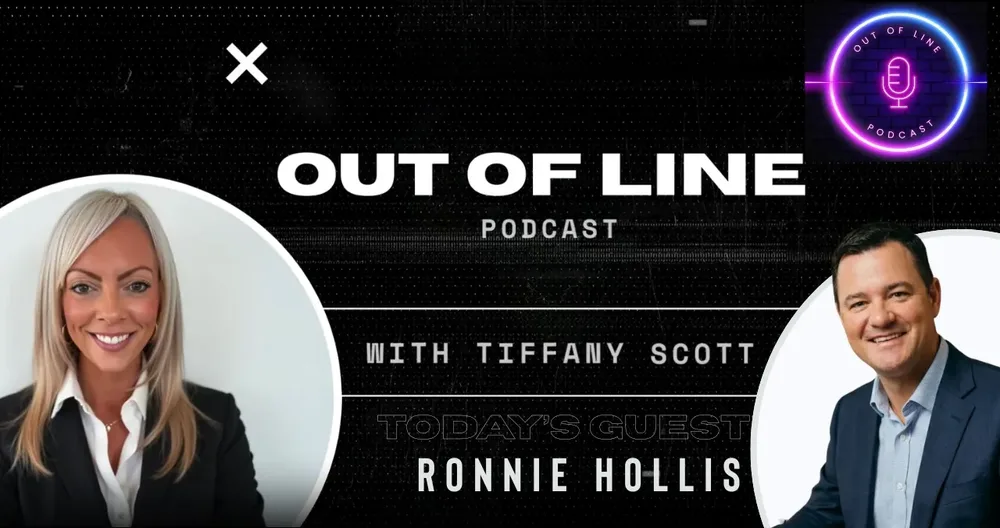
Ep. 8 of Out of Line with Tiffany Scott, with Ronnie Hollis.
Ronnie Hollis walked into staffing with a microbiology degree, a pregnant wife, and no connections in the industry. He turned down a pharmaceutical job at Merck to do it. More than 20 years later, he has built three companies and made the Inc. 5000 list multiple times. Along the way he survived the dot-com bust, the Great Recession, and prostate cancer.
On Episode 8, Ronnie gave me some of the most practical operator advice we've had on the show. It's especially useful if you run a staffing firm on a line of credit, which is most of us.
Ronnie founded Prestige Staffing, which grew from a tiny Atlanta shop into a multi-office national IT and healthcare staffing firm. He has since launched Monza Cloud and co-founded Talinaq with a former Special Forces partner.
The dot-com bust hit during Ronnie's first full year owning the business. They were small and had no money, so they moved into healthcare out of necessity. That brought enough stability to get by. As telecom and IT merged around 2001 and 2002, they started really growing IT, and the business took off. Awards and articles followed.
Then 2008 and 2009 hit. They were hoping to do $20 million in revenue that year and ended up around $12 million. In the fourth quarter, he says, basically everything shut down.
"The highs are higher, but the lows are lower."
If your firm has done well the last few years, take the hint from Ronnie: success makes your head bigger than it should be. Plan for the quarter when nothing closes.
Like most staffing companies, Prestige ran on a bank line of credit, because you pay your people before your clients pay you. During the recession, their bank turned on them. And earlier, Ronnie had used a lot of cash buying out his two outside investors. It was an amicable deal, and they got a great return, but it meant Prestige went into the downturn without much cash.
"And what you think is a cushion, you need to think at least 2x."
That's the sentence I'd tape to every new owner's monitor.
Early on, Ronnie couldn't afford an accountant. A bookkeeper came in once a month to close the books and taught him along the way, and Ronnie basically became his own CFO.
"You have to understand your numbers. You have to understand cash flow."
Without that understanding, he says, you can't make calls like hiring five people or opening another office. In staffing, the timing of when cash goes out and when it comes in is how firms get into trouble. As the business grew, he eventually built out a real CFO role, but he started by learning it himself.
His father-in-law also gave him advice during the recession that I think every owner needs. When Ronnie admitted he wasn't sleeping, he told him: "Everything is darker at night." At 2 a.m., you're always picturing the worst case.
When Prestige was about five people, everyone, Ronnie included, was still carrying a book. So they had a rule. During the work day, called A-time, everything was about production. No management talk. Then everyone went home, saw their families, and got back on a call at 9:30 at night for hiring decisions, process changes, and anything else that wasn't production.
"Everything's about production during A time."
If you're a player-coach running a desk and a firm, this is a simple way to keep the operational stuff from eating your selling hours.
This was my favorite part. Ronnie used his science background to decide where to expand. He took Atlanta as a baseline and, for the roles they placed most often, like Java developers, compared the number of job openings to the population. He built ratios across all their IT and healthcare skill sets and added them up to score each city.
Most firms pick their next office because somebody knows somebody there. A demand-to-population ratio is a much better starting point.
When I asked about his biggest challenge right now, Ronnie named two things. First, sorting through all the noise to find the tools that actually work. Prestige has people dedicated to testing tools, because a new one shows up every week. Second, getting the culture back, so people feel passion for the company again instead of just scraping by to close a deal.
He doesn't think AI is going to replace this industry. In his view, people still want to work with people they like.
Open your books and calculate how many months of payroll you could cover if revenue dropped by half. If the answer scares you, set a target for your cushion and a monthly amount to move toward it. Block your best hours for production and guard them. Before you open a new market, write down the criteria you'll use to judge it.
Connect with Ronnie on LinkedIn (linkedin.com/in/ronnie-hollis-a9655815) and find Prestige Staffing at prestigestaffing.com.
Ronnie picked new markets by measuring real hiring demand, not gut feel. That's the kind of signal I built myScout around, at the level of the individual companies your reps should be calling.
Get started today. See which companies actually use agencies, who owns the decision, and how they want to be approached.
Get Started →We start with your company: how you sell, who you want to win, and where you want to grow. Then we show you exactly how myScout fits that. No canned walkthrough.
No. Start now and book a demo any time, before or after you buy.
Scout Pro is $199 and Scout Signature is $299, per user a month. Month to month, or pay annually and get 2 months free.
No. Unused credits carry forward as long as your plan is active.
That is Enterprise, priced around your team size. Contact us and we will build it with you.