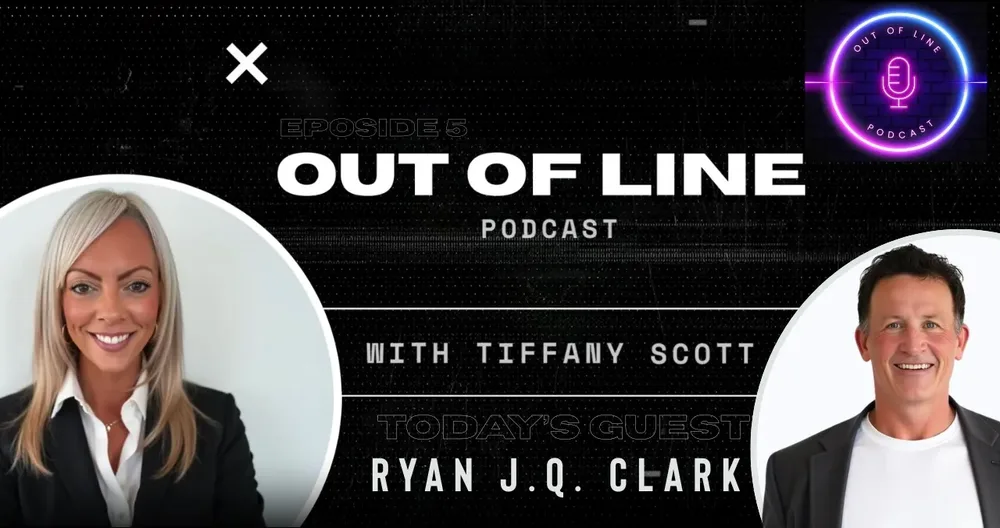
Ep. 5 of Out of Line with Tiffany Scott, with Ryan Clark.
Ryan Clark co-founded PeopleShare in 2005 with no outside money and one business partner. By the time they sold it in 2023, the company had grown to 40 branches across eight states and close to $200 million in annual revenue. It also won Best Places to Work from the Philadelphia Business Journal every year it was eligible.
This one is personal for me, because I know PeopleShare well. Even so, Episode 5 gave me plenty I hadn't heard before about how Ryan and his partner Dave thought about the business from day one, and what Ryan would do differently.
Ryan learned staffing at Today's Staffing, which later became part of Randstad. He and Dave, a colleague there, wrote a business plan on weekends, quit on the same day, and opened PeopleShare on January 1, 2005, out of King of Prussia, Pennsylvania. Ryan served as co-CEO, and in the early days he was also the recruiter, salesperson, receptionist, and accountant. They made it through the 2008 recession, built PeopleShare into one of the fastest-growing staffing companies in Pennsylvania, and sold to an international staffing company in 2023.
Ryan laughs about how most entrepreneurs start out: they figure they can make a better burger than the chain they work for. For him, the real reason came from a small, awkward moment. He was visiting a client in Old City, Philadelphia, and she offered to introduce him to the person his firm had just placed. The candidate didn't know who Ryan was or what company he was from. Nobody from the agency had ever met him.
"there was a huge gap in the marketplace to to improve the customer service."
If you're building or rebuilding a firm, start there. Find the moment where your client can tell you don't really know your own product.
That moment became PeopleShare's rule of seeing every candidate three times before a placement. That meant two meetings plus an orientation to set them up for success, borrowing the interview prep he'd seen in pharma. I saw why it mattered early in my own career. I was working an executive admin search and figured my candidate, who had supported CEOs her whole career, didn't need prep. In the mock interview, she was a disaster. The process caught it before the client did.
The lesson for owners is that a process people roll their eyes at is often the one that keeps your best client.
Ryan was refreshingly modest about what made PeopleShare work.
"We just took a a tried and and true business model and improved it"
You don't need a revolutionary idea to grow a staffing company. You need to do the basics better and more consistently than the shop down the street.
When I asked how they went from one office to 40, Ryan said the biggest reason might surprise me. They were laser focused on goals. He and Dave set one-, three-, and five-year goals, wrote them down, and built strategy meetings around them, including a rallying cry of $100 million by 2015. He called Brian Tracy's Goals the most influential book he's read. Second was Andre Agassi's autobiography, because Agassi rewrote his specific goals every morning while climbing out of a slump.
You don't have to wake up at 5 a.m. to rewrite your goals. But if your team can't repeat your three-year target, it isn't really a target.
Ryan was candid about his own leadership. He described his early style as a little rough and said he had a short fuse.
"leadership is is a lot like poker. It takes five minutes to learn the game, a lifetime to become an expert to master."
He said he was a good leader for strong people and not the best one for marginal performers, and that some people churned out because of it. That kind of honesty is rare in an owner, and it's worth hearing if you're promoting your first managers.
The thing Ryan said he'd do better is set expectations. In recruiting and sales, everyone pitches the great job and the great company. Toward the end, he started doing the opposite.
"I'm going to tell you the ugliness of this business."
He told new hires how hard it would be, how he'd talk to them, and the kind of accountability they'd get. Staffing isn't for the faint of heart, and the people who still sign up after hearing that tend to stick.
Write down the one service gap your firm closes that the competition doesn't, in a sentence a client would repeat. If you can't, that's the work. Then put your team's goals somewhere everyone sees them every week. When you hire, tell the candidate the hardest part of the job before they accept. You'll keep the ones who stay.
Connect with Ryan on LinkedIn: linkedin.com/in/ryanjqclark
PeopleShare grew by doing the basics better than everyone else, and selling was one of those basics. Making the research behind every sales call faster is what I'm building myScout to do.
Get started today. See which companies actually use agencies, who owns the decision, and how they want to be approached.
Get Started →We start with your company: how you sell, who you want to win, and where you want to grow. Then we show you exactly how myScout fits that. No canned walkthrough.
No. Start now and book a demo any time, before or after you buy.
Scout Pro is $199 and Scout Signature is $299, per user a month. Month to month, or pay annually and get 2 months free.
No. Unused credits carry forward as long as your plan is active.
That is Enterprise, priced around your team size. Contact us and we will build it with you.