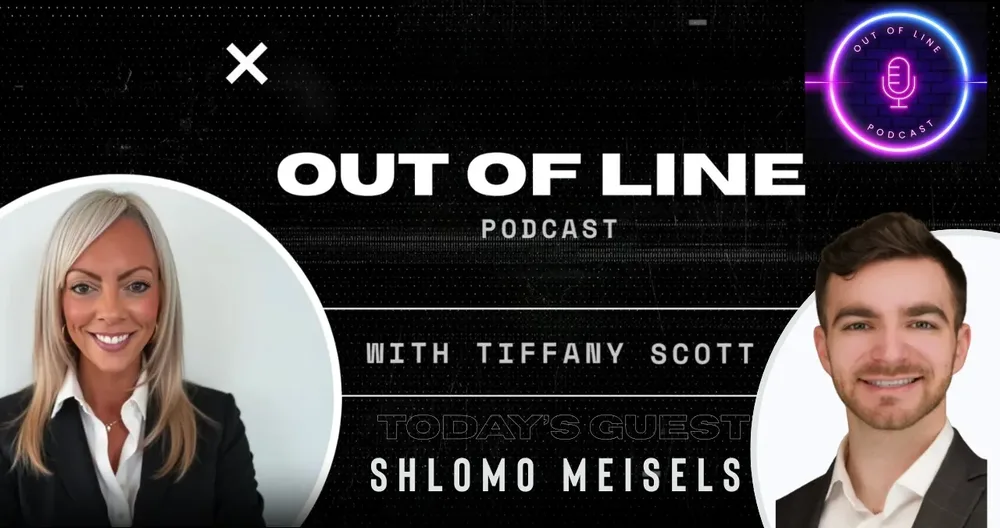
Ep. 9 of Out of Line with Tiffany Scott, with Shlomo (Steven) Meisels.
Shlomo Meisels didn't come up through a staffing firm. He watched friends come out of college with no job offers and nobody helping them, so he started WhatsApp groups to connect people with work. Those group chats became a business, and that business became SM Staffing, which now places people across all 50 states.
On Episode 9, Shlomo and I talked about how he built a firm with no industry background, and his strong opinions on what most agencies get wrong about fit. Even if you disagree with him on niching down, his intake process alone is worth the listen.
Shlomo, who also goes by Steven, is the founder of SM Staffing. It's a national firm built around matching for culture fit over credentials, and it doesn't charge job seekers. He also coaches recruiters and early-stage business owners one-on-one, and he writes regularly about what companies get wrong when they build teams. He told me he has 12 recruiters on staff plus a sales team.
Shlomo's first placement came from a mentor's client, a manager role he filled for about $500. That proved he could do it. But what he actually had at the start was distribution.
"all I had I didn't really have experience recruiting, but I had group chats. So, I leveraged that,"
After COVID, a lot of new mom-and-pop businesses needed salespeople and admins but didn't want to pay full recruiting fees. He sold job posts in his group chats for about $100 each, and while still in college he was on pace to make about $50,000 a year. It's a good reminder that an audience who trusts you is an asset, whether it's a group chat, a LinkedIn following, or a newsletter.
Shlomo calls himself the culture-matching recruiter, and he still doesn't romanticize work.
"we work to make money. That's why we work."
His point is that coworkers who pull people away from that goal with distractions aren't being fair to them. He also thinks people should bring their real selves to work while reading the room. Whether or not you agree, it's a useful frame for talking with candidates about pay. Money is a legitimate reason to make a move, and pretending otherwise just wastes everyone's time.
Shlomo isn't a big believer in assessments. Candidates can often guess what personality a job wants from the job description, or just look up how to get the result they need.
"So, a lot of times people are trying to mess with these exams and tests and whatever."
He doesn't think candidates who do that are bad people. They just want to get in front of a human. If your process leans heavily on a test score, ask yourself what it's actually measuring.
So how does he match for culture? It starts with the client intake call, and he spends much longer on it than most recruiters. He goes beyond day-to-day tasks and asks about the current team and their personalities, the mission, whether they want someone who clocks in and out or someone who finishes the work efficiently and leaves, and whether the team works collaboratively or assembly-line style. Above all, he asks why they've been successful, both on the work side and the human side.
He also puts real work into the follow-up questions, both on intake calls and with references. That's where you read between the lines.
Shlomo makes an argument that niche agencies won't love. He thinks part of why turnover is so high is that niche firms send candidates with the right experience who still don't fit the team.
"every single person doesn't fit every single company culture."
His firm's research found what you'd expect: the two biggest reasons people leave are money and culture fit. He's had clients ask why a person who struggled with them is now thriving somewhere else.
"people who enjoy where they work work better."
If retention is your client's pain point, that's your pitch.
Shlomo was candid that he hears "niche, niche, niche" everywhere, and that coming straight out of college means he lacks deep corporate experience in specific industries. His recruiters specialize, even if the firm doesn't. I told him I believe in doing one thing really well, and he isn't there yet. That's an honest conversation for any growing firm.
On your next intake call, spend half the time on the team instead of the tasks. Ask who the candidate will sit next to, how the manager gives feedback, and who left and why. Write those answers into the job order. Then track ninety-day retention on your placements, because fit is a number you can show clients when you sell.
Connect with Shlomo on LinkedIn (linkedin.com/in/shlomo-meisels-smstaffing) and at SM Staffing (smstaffingjobs.com).
Shlomo's intake call works because he learns the team before he pitches anyone. The same principle applies to business development, and it's why I built myScout to show you what a company is hiring for before your first call.
Get started today. See which companies actually use agencies, who owns the decision, and how they want to be approached.
Get Started →We start with your company: how you sell, who you want to win, and where you want to grow. Then we show you exactly how myScout fits that. No canned walkthrough.
No. Start now and book a demo any time, before or after you buy.
Scout Pro is $199 and Scout Signature is $299, per user a month. Month to month, or pay annually and get 2 months free.
No. Unused credits carry forward as long as your plan is active.
That is Enterprise, priced around your team size. Contact us and we will build it with you.