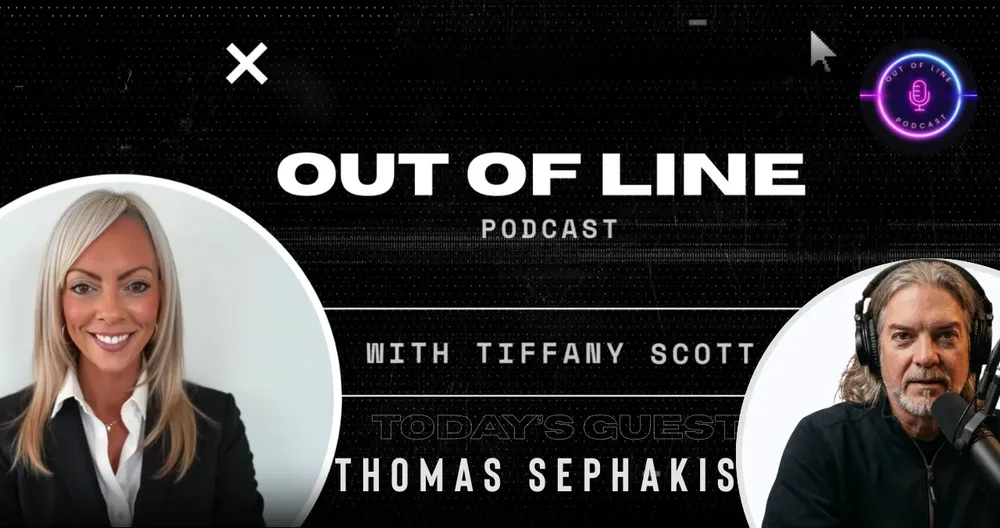
Ep. 2 of Out of Line with Tiffany Scott, with Thomas Sephakis.
Some people build one staffing company and spend their whole career there. Thomas Sephakis has built, bought, sold, and restarted staffing businesses more times than most people change jobs. Somewhere along the way he also won a best actor award at a sci-fi film festival.
When I sat down with Tom for Episode 2, I expected war stories, and I got them. What I didn't expect was how grounded he is about the business side. He has run a company at $60 million in revenue, and he has chosen to run one much smaller. He's clear about why.
Tom started on the franchise side of staffing with Western Staffing, which later became Westaff, and that path took him from Pittsburgh to Philadelphia. Since then he has built a tech company and a job board, consulted for staffing firms, and helped grow a pharmaceutical contract staffing business to about $60 million before a national company bought it. Today he runs Intelligent Staffing, which covers light industrial, finance and accounting, healthcare, education, payroll, and employer of record services. He also started a residential and commercial cleaning business out of Pottstown that passed 60 clients in its first year. Outside of business, he writes, acts, and produces films.
Tom has seen both ends of the scale. At around $60 million, he says, they hit a wall, and the problems grew right along with the revenue. Now he keeps Intelligent Staffing in roughly the $5 million to $12 million range, depending on the year, and that's a choice.
"the more successful you get, the worse it gets and the more frequent it is, too."
That's not an argument against growth. It's a reminder to decide what size business you actually want to run. Plenty of owners chase the next revenue milestone without asking whether the life that comes with it is the one they signed up for.
When the pharma staffing business sold, Tom had a non-compete. He kept Intelligent Staffing, shut it down for a year, and reopened it once he was free to compete again. He didn't try to get around the agreement. He waited it out and rebuilt.
If you're an owner, read your deal terms like they'll matter, because they will. Your timeline for a second act depends on what you agreed to in the first one.
This was my favorite moment. Tom told me about a recent call with one of his salespeople, getting ready to present to a new client. The rep asked how Tom wanted to be introduced.
"Just just just Tom. Just introduce me."
He told the rep he was a partner on that call, not a CEO. Titles can carry weight in a boardroom, but he doesn't think that's what wins staffing business:
"we're selling them on partnership. We're selling them on personality."
I've seen this from the other side for years. Clients sign with people they trust. A big title can actually get in the way, because it signals that you won't be the one picking up the phone when something goes wrong.
Tom was blunt about people who chase titles. The higher you go, he said, the more problems come up the ladder to you. Being the owner of a small firm means you're the CEO, the front desk, the phone person, and the one taking out the trash.
"They always look at the success, but they don't realize what you got to do to get there."
If you're coaching a rep who wants to run their own desk or their own firm someday, make sure they hear this part too.
Tom's cleaning company is a good example of leaning on what he already knows: hiring, managing a workforce, and selling to commercial buyers. He's taking skills built in staffing and applying them to a service business with its own customers. You don't need to copy that, but it's worth looking at what else your operation already knows how to do well.
Tom wanted to join the military, and he was turned down by the Army, the Navy, and the Air Force because of asthma and a heart murmur. He's had wins and losses in business, and a cancer diagnosis a couple of years ago that made him take stock. He says you learn from your failures, not your successes, and that the people with an air about them usually don't last in this business.
Decide what size business you actually want to run, and write down why. If you have partners or investors, reread your exit terms now, while nothing is at stake. In your next client meeting, leave the title at the door and talk about the problem in front of you. That's the partnership clients are buying.
Connect with Tom on LinkedIn: linkedin.com/in/thomas-sephakis
Tom sells partnership, not titles, and that only works when you show up knowing the client's world. That's what I built myScout to help with: walking into the first conversation already knowing what a company is hiring for.
Get started today. See which companies actually use agencies, who owns the decision, and how they want to be approached.
Get Started →We start with your company: how you sell, who you want to win, and where you want to grow. Then we show you exactly how myScout fits that. No canned walkthrough.
No. Start now and book a demo any time, before or after you buy.
Scout Pro is $199 and Scout Signature is $299, per user a month. Month to month, or pay annually and get 2 months free.
No. Unused credits carry forward as long as your plan is active.
That is Enterprise, priced around your team size. Contact us and we will build it with you.